“Twenty years from now you will be more disappointed by the things that you didn’t do than by the ones you did do. So throw off the bowlines. Sail away from the safe harbor. Catch the trade winds in your sails. Explore. Dream. Discover.” – Mark Twain
Our trip to Israel was wonderful. Eye opening. Life changing.
If you know me, you know that I love to travel. In fact, I live to travel, and I definitely work so I can travel! And while I like to occasionally go on a relaxing trip to the beach, I LOVE to go somewhere new, to explore the unknown, and to learn something new about a place & culture, and if I'm lucky, about myself. While I've been fortunate to have been able to visit a lot of places in my life, I still consider myself an amateur when it comes to seeing the world...... meaning, I have a lot of places still on my Bucket List!
In early May, we spent 6 days in Jerusalem, and 3 days in Herzliya (a beach resort town north of Tel Aviv). We used Jerusalem as our base for visiting a few sites to the East (Masada, Dead Sea, Ein Gedi, Bethlehem). There are more than a few places we didn't get to visit (Galilee, Haifa & Mount Carmel). Not enough time, maybe someday...
So I'll start with Jerusalem. We had a tour guide for the 1st 3 days. Tamar. She was great. I am not normally someone who likes having a tour guide - I like to explore on my own and do my own thing. But in this case, it was so helpful and made the trip.
So before I show you my pictures, here's a few maps and a few facts. The city of Jerusalem covers 48 sq. miles, is 2600 ft. above sea level, and has a population of around 700,000 people. It's Israel's largest city and also its capital. The population consists of approximately 65% Jews, 33% Muslims, and 2% Christians.
The core of the city, the "old city" is walled and split into 4 quarters: Armenian, Jewish, Muslim, and Christian. The old city has a history stretching back at least 3,000 years (from the times of King David, who according to the Bible captured Jerusalem and made it the Israeli capital and started to create the 1st Jewish nation).
The quarters themselves were established during the Byzantine era (5th Century), but the current layout is more recent, from the early 19th century. The walls were built in the 16th Century during the Ottoman rule.
Surrounding the old city are hills: Mount Scopus (north), Mount Herzl (west), Mount Zion and Mount of Olives (east).
And within the old city, Mount Moriah, which is arguably the most hotly contested spot of land on the earth. Mount Moriah is the holiest site in Judaism. It's the location of the Temple Mount, where the First and Second Jewish temples were build & once stood, and where Jewish tradition says the Third and final temple will be built. According to Jewish tradition, it's also where the Arc of the Covenant was kept during the First Temple. And it's the spot of Abraham's binding of Isaac (from the Book of Genesis) - where Abraham was asked by God to sacrifice his son Isaac.
But it's also a very sacred spot for the Muslim faith. It's currently the location of the Dome of the Rock (built in the late 600's by the Muslims), and is considered their third holiest site because tradition says it's the spot of Muhammad's ascension to Heaven, where he spoke to the prophets & to God and was told instructions regarding the details of prayer (during his Night Journey).

So we started our adventure on the Mount of Olives. The gold dome is the Dome on the Rock (which the Muslim built in 691 on the Temple Mount - the Temple Mount is the location of the First Temple (900 - 587 B.C.) and Second temple (515 B.C. - 70 A.D). Build on the same spot as a way of saying "we claim this spot".
So the Old City is in the background. Closer to us are the Jewish Cemeteries, some dating back as far as 2300 BC (or so it is said). There are over 150,000 graves. We were told many Jews throughout the world wish to be buried in this spot, because it is close to the "Valley of Jehoshaphat", where "mankind will be resurrected on the Day of Judgment". And that today, it is mostly wealthy Americans or Russians who can afford these plots.
The view to the North. On the right is a Benedictine convent. On the left is the Dominus Flevit Sanctuary, which means "The Lords Wept", and it is believed to be on the spot that Jesus wept over the fate of Jerusalem.
The City of David to the south. The oldest part of Jerusalem, there are reportedly 13th Century B.C.
walls and building remains from the 6th Century B.C. within the city.
Another Old City view, with the 8th Century El-Aqsa Mosque in the center (the main place of worship in the city for the Muslim population)
Tomb of Benei Hezir and Tomb of Zechariah. The Tomb of Benei Hezir (roughly "sons of Hezir", a name that is referred to in the Bible) dates to the 2nd Century BC, and is believed to be a set of burial caves built for a wealthy family. The tomb of Zechariah is for a priest and prophet in the Hebrew Bible, Zechariah Ben Johoiada.
Tomb of Absalom, 1st Century BC. Absalom was the "rebellious son of King David" . It is apparently a custom for passersby to throw stones at the monument.
Further down the side of the mountain is the Basilica of the Agony & Garden of Gethsemane. The church is named for the rock in the garden when legend says Jesus prayed before he was arrested.
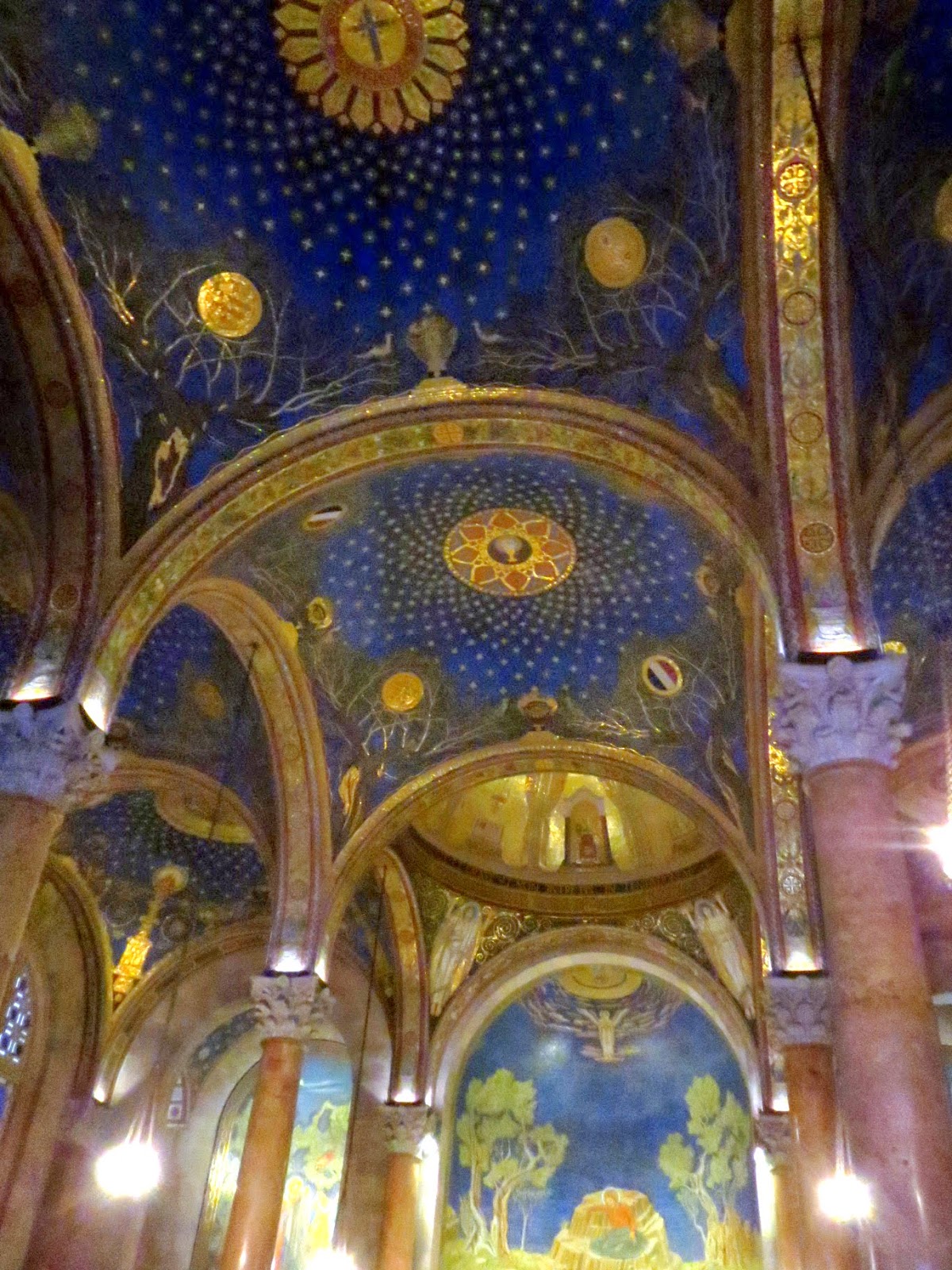
The basilica is also known as the Church of All Nations & is fairly new (1924), but several churches were on this site before it, as far back as the 4th Century. It was built from donations from 12 nations.
Legends says that the Garden of Gethsemane is where Jesus prayed, and his disciples slept the night before his crucifixion. The olive trees in the gardens are centuries old.
You can see the Byzantine influences inside the Basilica. All the art are mosaics
My favorite tree
Also in the gardens is the Church of St. Mary Magdalene, a Russian Orthodox church, built relatively recently in 1885. Only accessible if you are Russian. I should have been granted a special pass!
So next we moved into the city, to the Western Wall. The Western Wall is names for the western section of the retaining wall of the Temple Mount, and was built by Herod the Great during his expansion of the Second Temple in 37-35 B.C. It is considered Judaism's holiest site. During the Ottoman period, the wall became the spot where the Jews would come to pray and lament the loss of the Temple, which is why for centuries it was also known as the Wailing Wall.
Non-Jews can approach the Wall and pray, as long as they are dressed appropriately and men cover their heads. Both Pat and I entered our respective sections and left a note in the cracks of the wall
We also did a very interesting tour underneath the wall and through the tunnels.
Here you can see original sections of the Temple. British researchers started excavations of this area in the mid 19th Century.
This water channel originally supplied water to the Temple Mount
This is the biggest stone discovered, called the Western Stone. It ranks as one of the heaviest objects lifted by man without machinery. 45 ft. long, 10 ft. high, 11-15 ft.. wide, with an estimated weight of 510 tons.
We visited the Western Wall at night at the beginning of Shabbat (Friday at Sundown) and the end of Shabbat (Saturday at sundown, after three starts can be seen in the night sky). I didn't take pictures on Friday night out of respect as was requested. The crowds were unbelievable on Friday. Less on Saturday, but still special to witness.
That's all for now. Much more to come.................